Fiber vs. cable vs. 5G home internet: which should you get?

Most ISP marketing focuses on download speed, which is only one dimension of what makes an internet connection good or frustrating to use. The type of technology delivering the connection - fiber, cable, or 5G - affects consistency, upload speeds, latency, and how performance holds up when the whole neighborhood is online at the same time.
Fiber internet
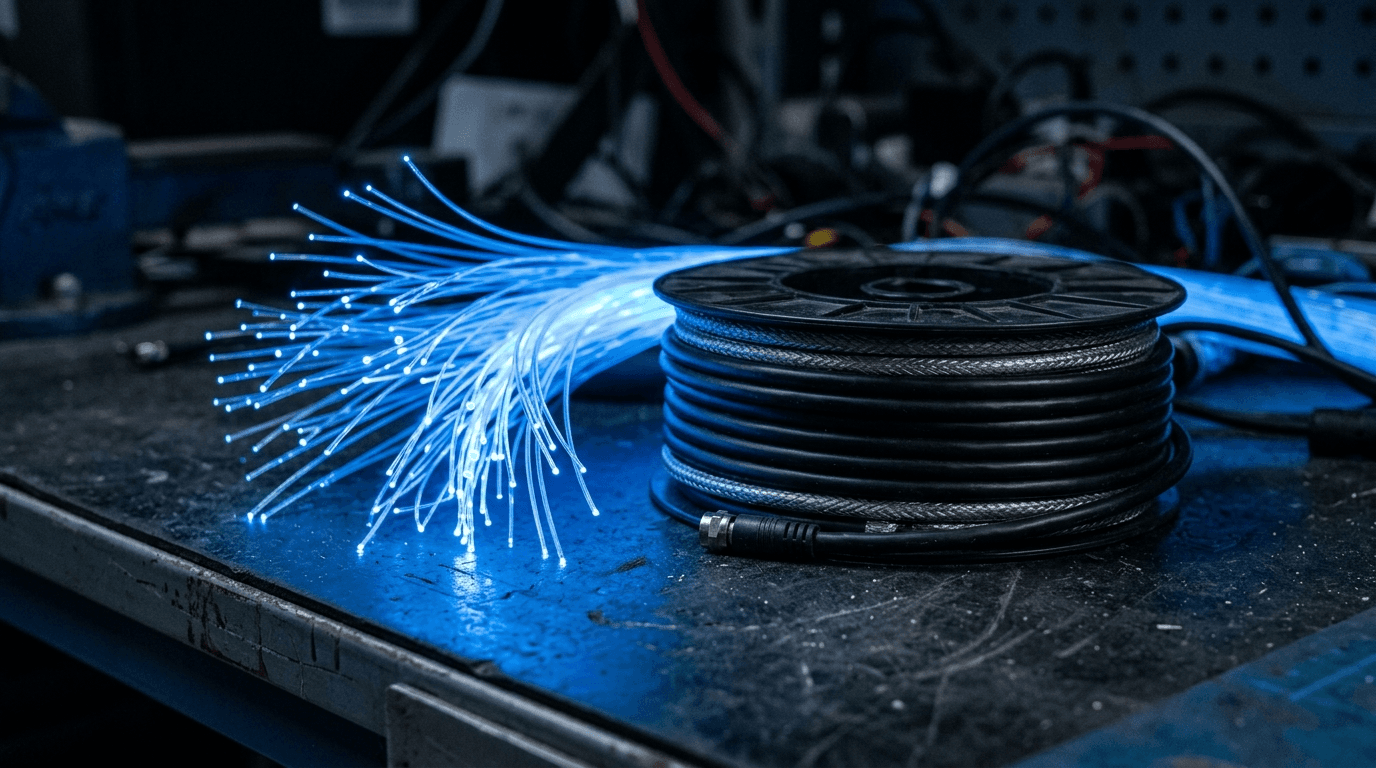
Fiber-optic internet transmits data as pulses of light through glass or plastic cables dedicated to your connection. Because your fiber line does not share capacity with neighbors, speeds are consistent regardless of how many people in your area are online. Upload and download speeds are symmetrical - a 500 Mbps fiber plan gives you 500 Mbps in both directions.
Symmetric upload is the difference that matters most for remote workers. A 1 Gbps cable plan might give you 1 Gbps download and only 35 Mbps upload. A 500 Mbps fiber plan gives 500 Mbps in both directions. For video calls, file uploads, and cloud sync, the upload speed is the bottleneck - and fiber removes it.
The limitation is availability. Fiber requires running new physical cables, which is expensive. About half of US homes have access to fiber today, concentrated in urban and suburban areas. Rural and exurban addresses are far less likely to have a fiber option.
Cable internet
Cable internet runs over the same coaxial cable infrastructure used for television, delivering data via DOCSIS technology. It is the most widely available high-speed option in the US, reaching roughly 90 percent of homes.
Cable uses shared neighborhood infrastructure - your connection shares capacity with neighbors on the same cable segment. During peak hours (evenings, weekends), speeds can drop significantly on heavily loaded nodes. We measured drops of 30 to 50 percent from advertised speeds during evening hours at several cable providers in testing. ISPs manage this by upgrading node capacity over time, but congestion is a real and variable factor.
Upload speeds on cable are significantly lower than download speeds. Most cable plans offer 10 to 40 Mbps upload on plans with 300 to 1,000 Mbps download. This is improving with DOCSIS 3.1 deployment, but the asymmetry remains pronounced compared to fiber.
5G home internet
5G home internet (T-Mobile, Verizon) uses the same cellular network that phones use, delivered to a fixed indoor gateway device. No cables are run to your home; the gateway communicates wirelessly with a nearby tower.
The advantage is simplicity and flexibility: no technician visit, no installation appointment, no contract. The limitation is that wireless capacity is shared among all users connected to the same tower, and performance varies with distance, obstacles, and network demand. Speeds in our testing ranged from under 50 Mbps to over 400 Mbps depending on time of day and tower conditions.
5G home internet works well for households in areas with strong T-Mobile or Verizon 5G coverage that need a simple, contract-free option. It is not the right choice for households that need guaranteed minimum speeds for professional use or gaming.
DSL: the fourth option you probably should not take
DSL delivers internet over copper telephone lines and is still available in rural areas where fiber and cable have not been built. Speeds top out at 25 to 100 Mbps on newer VDSL technology and often fall short of those numbers at distance from the telephone exchange. If DSL is your only option, T-Mobile Home Internet is worth checking first - in most areas where DSL is the only wired choice, T-Mobile's 5G coverage is available and significantly faster.
Frequently Asked Questions
Senior Staff Writer
Alex has covered telecom, smartphones, and business communications for eight years. Before DeltaThree, he tested gear for a carrier trade publication and ran the wireless desk at a consumer tech site. He pays his own phone bill.